
How to Look Up Divorce Records in California
You might be trying to prove your divorce for a name change, government application, or immigration paperwork. Or maybe you’re just trying to confirm whether a divorce was finalized.
Whatever the reason, knowing how to look up divorce records in California can make the process a lot easier.
California divorce records are public documents, but finding the right office, form, or link can be confusing. This guide breaks down the process step by step so you can locate and request what you need without wasting time.
What Divorce Records Show
When a couple divorces in California, the court keeps an official record of the case. Depending on what you need, there are three main types of records:
- Divorce Certificate – A simple document that confirms the divorce took place, including both spouses’ names, the court location, and the date the divorce was finalized.
- Divorce Decree – The official court judgment that outlines the terms of the divorce, including property division, child custody, and spousal support.
- Divorce Case File – The complete record of the entire case, containing all filings, motions, and court rulings.
If you only need proof of divorce for personal or government purposes, a certificate is usually enough. But if you are resolving custody issues or modifying orders, you will likely need the decree or full case file.
Are Divorce Records Public in California?
Yes, most divorce records are public under the California Public Records Act.That means anyone can request to see them, except for parts the court has sealed to protect privacy.
Courts often restrict access to:
- Financial account details
- Information involving minors
- Domestic violence restraining orders
- Adoption or medical information
These restrictions exist to protect the safety and privacy of the people involved. For example, a judge may limit access if a record contains sensitive financial data, addresses, or details about children.
In these cases, only the spouses, their attorneys, or authorized court officials can view or request copies of the sealed portions. Members of the public can still see basic case information, but full access requires a court order.
So while the case record itself is considered public, some pages or attachments may be confidential to safeguard personal or family privacy.
Follow These Steps to Find Your Divorce Record in California
Step 1: Identify the County Where the Divorce Was Filed
California does not have a single statewide database for all divorce cases. Records are stored in the Superior Court of the county where the divorce was filed.
If you do not know which county handled the case, try:
- Looking at past mail or legal documents
- Checking old addresses during the marriage
- Searching through California’s Find My Court directory
Once you identify the county, you will know which court to contact for copies.
Step 2: Search Online for the Divorce Record
Many California counties now offer online court search tools where you can look up divorce cases by name or case number. Some examples include:
- Los Angeles County: LACourt.org
- Orange County: OCCourts.org
- Riverside County: Riverside.Courts.CA.gov
- San Bernardino County: SB-Court.org
These systems usually let you:
- Verify case status (filed, pending, finalized)
- See hearing dates and outcomes
- Request copies online or print summaries
Keep in mind that each county’s system looks different. Some charge small access or copy fees.
Step 3: Request a Certified Copy of Your Divorce Record
If you need an official copy for legal or personal reasons, you will have to request a certified copy. Certified copies are often required for name changes, remarriage, or government applications.
You can request one in several ways:
- In person: Visit the county Superior Court Clerk’s Office where the divorce was filed.
- By mail: Send a written request that includes the full names of both spouses, the case number, and the approximate date of filing.
- Online: Many counties allow certified copy requests through VitalChek for secure online processing.
Most counties charge between $10 and $20 per copy.
Processing times vary depending on how you request it:
- In person: Often available the same day, depending on court workload.
- By mail: Usually takes 2 to 4 weeks once your request and payment are received.
- Online (VitalChek): Typically 2 to 3 weeks, plus mailing time for certified copies.
If you need the record urgently, contact the court clerk ahead of time to confirm processing times or ask about same-day pickup options.
Step 4: Contact the California Department of Public Health (CDPH)
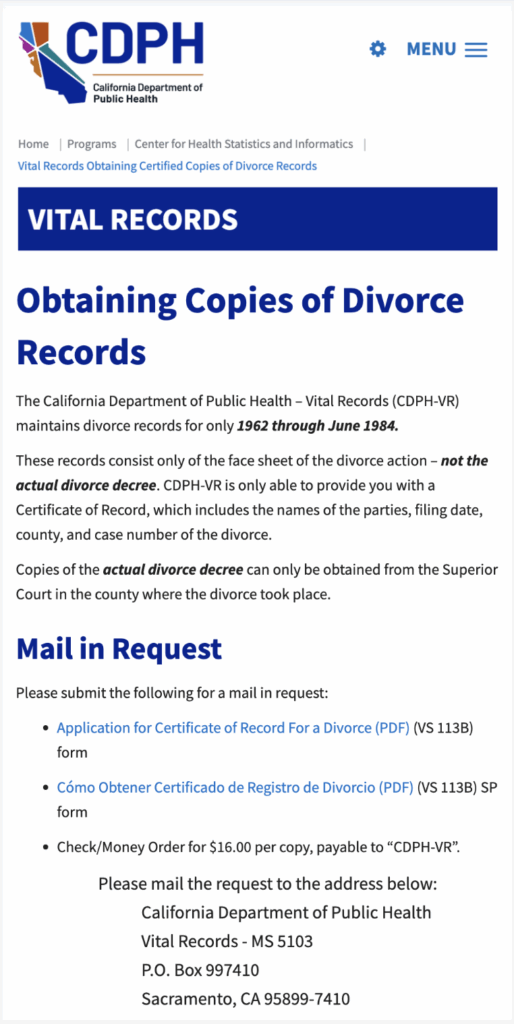
If you do not know which county the divorce took place in, you can reach out to the California Department of Public Health – Vital Records (CDPH-VR).
The CDPH maintains a limited index of divorces from 1962 through June 1984. It includes the names of both spouses and the county where the divorce was filed, but not the details of the case or judgment.
To learn how to request a certified copy, visit the California Department of Public Health’s official instructions page. You will find current fees, request forms, and mailing addresses there.
If the divorce happened after 1984, contact the county court directly.
Step 5: Visit the Courthouse for Older or Archived Cases
If your divorce took place decades ago, the record might be stored in the courthouse archives or on microfilm. To access it:
- Visit the county’s Superior Court Clerk’s Office.
- Provide the parties’ names and approximate date of divorce.
- Ask if the case is archived or available digitally.
- Request retrieval or copies.
Older records may take several days to locate. If the file is very old, you may be referred to a storage facility or state archive.
Step 6: Accessing Sealed or Restricted Divorce Records
If a divorce record is sealed, only certain people can access it:
- The spouses
- Attorneys involved in the case
- Authorized court officials
To request access, you will need to file a motion to unseal the record. The court will review the motion and decide if there is a valid reason to grant it. A family law attorney can help with this process.
Common Reasons People Look Up Divorce Records
There are many reasons you might need to locate a divorce record in California, including:
- Verifying marital status for a new marriage license
- Changing your last name on legal documents
- Confirming child or spousal support orders
- Applying for immigration or citizenship
- Handling estate or inheritance issues
Whatever your reason, keeping these documents organized can help you avoid future delays or legal problems.
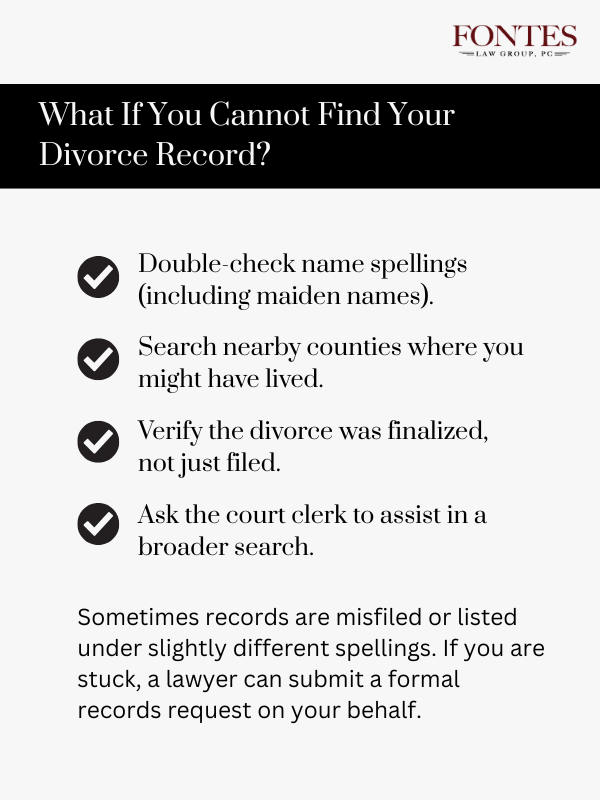
What If You Cannot Find Your Divorce Record?
How Fontes Law Group Can Help
At Fontes Law Group, we help clients across Southern California find and access important court records, including divorce decrees, custody orders, and judgments.
Our attorneys understand that these documents are more than just paperwork. They often impact your ability to remarry, adjust immigration status, or secure your rights as a parent.
With offices in Santa Ana and Riverside, our bilingual team (English and Spanish) helps families navigate the California court system with care, clarity, and compassion.
If you are having trouble finding a divorce record or need legal help interpreting what it means for your case, we can guide you every step of the way.
Helpful Resources
- California Courts: Find My Court
- California Department of Public Health – Vital Records
- California Judicial Branch: Self-Help – Divorce
- California Attorney General: Public Records Act
Frequently Asked Questions About California Divorce Records
Q: Are divorce records public in California?
Yes. Most divorce records are public, but parts involving children or sensitive financial data may be sealed.
Q: Can I find divorce records online?
Yes. Many county courts offer online case search tools, though access varies by county.
Q: How much does it cost to get a certified copy of a divorce decree?
Typically $10 to $20, depending on the county and delivery method.
Q: What if I do not know the county where the divorce was filed?
Contact the California Department of Public Health – Vital Records for help identifying the county.
Q: How long does it take to receive my record?
In-person requests may be fulfilled the same day. Online or mail requests usually take two to four weeks, depending on processing times and mail delivery.
Bottom Line
Divorce records are public in California, but finding them takes some patience and the right steps. Start by identifying the county, search online, and contact the court or CDPH if needed.If you hit a wall, do not stress. Fontes Law Group can help. Our bilingual attorneys in Santa Ana and Riverside assist clients across Southern California with divorce records, court filings, and post-divorce issues like support, custody, and name changes.