


California Divorce Process in 7 Steps
Going through a divorce can be both emotionally and financially devastating. It’s rarely an easy decision.
When a person decides to move forward with a divorce, it marks the beginning of an important legal process.
The good news is that the California divorce process generally follows a clear structure. California divorce is governed by state laws, primarily the California Family Code, along with court rules and procedures.
There are required steps you must follow, including filing a petition, serving your spouse, completing financial disclosures, and observing the mandatory six-month waiting period before your divorce can be finalized.
When you understand what to expect, it becomes easier to prepare and make informed decisions.
Working with an experienced divorce lawyer at Fontes Law Group can help you protect your rights every step of the way.

Step 1: Before You File
The divorce process often starts before anything is filed with the court. This is where preparation can make a big difference.
Before filing, it’s important to understand your financial situation and gather key documents. Having everything ready early can save you time and stress later.
Some of the steps you should take include:
- Speak with a financial advisor to understand the potential impact of your divorce. This advisor should be independent from your spouse.
- Gather important documents, including:
- Tax returns
- Business profit and loss statements
- Property deeds
- Vehicle titles
- Bank and savings account statements
- Retirement and investment account statements
- Gather documents showing debts, such as:
- Credit card statements
- Mortgage statements
- Auto loans
- Student loans
- Open a bank account in your name alone.
- Open a separate mailing address, such as a P.O. box, for private communication with your lawyer.
It’s usually easier to gather these documents before your spouse knows about the divorce. Waiting until later can make the process more difficult.
Step 2: Initiate Your Divorce Case
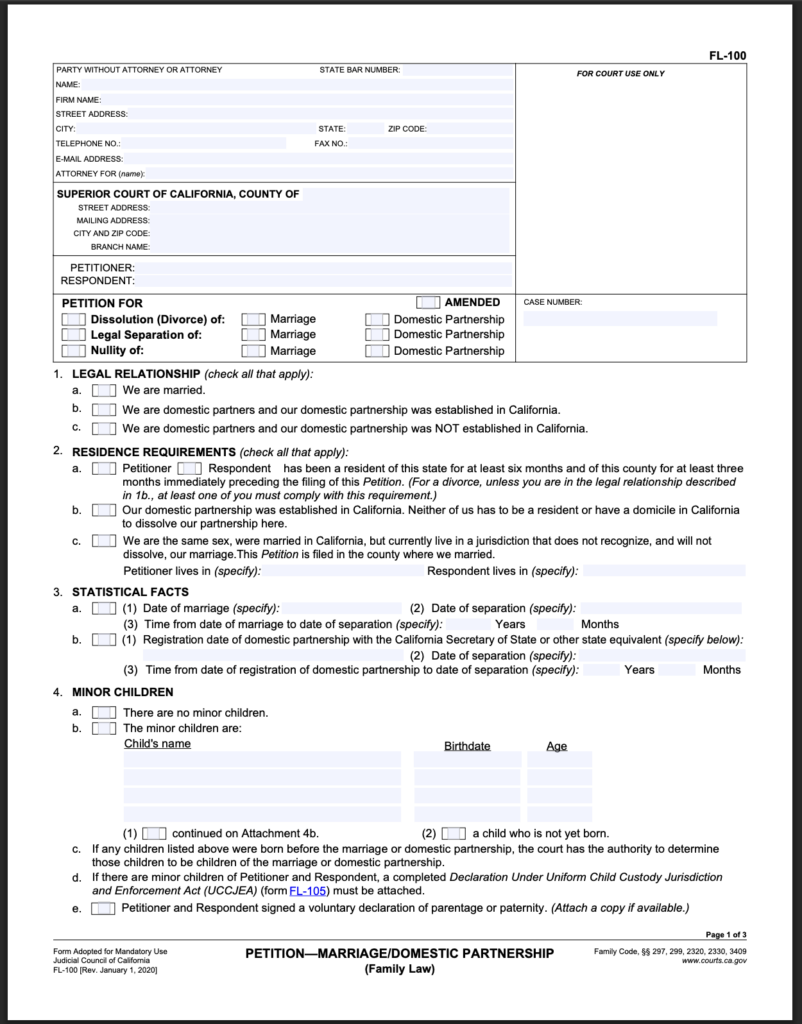
The divorce officially begins when one spouse files a petition for dissolution. The person filing is called the petitioner, and the other spouse is the respondent.
You’ll need to file documents with the court in your county and pay the required fees. These documents provide basic details about your marriage and what you’re asking the court to decide.
The required documents include:
- Petition for Dissolution
- Summons
- Preliminary Declaration of Disclosure
- If you have children, the Declaration under the Uniform Child Custody Jurisdiction and Enforcement Act (UCCJEA)
The petition outlines your requests, such as child custody, support, or division of property. It can also include requests for spousal support and attorney’s fees.
Step 3: Service of Process
After filing, your spouse must be officially notified. This step is called service of process.
Someone who is at least 18 years old must deliver the documents. Many people choose to use a professional process server or the Sheriff’s Department.
The papers can be served in different ways:
- Personal service (preferred)
- Service by mail
- Waiver of service (if your spouse agrees)
- Service by publication (if your spouse cannot be located)
Once completed, proof of service is filed with the court. This confirms that your spouse received notice of the case.
Step 4: Response
After being served, your spouse has 30 days to file a response. This allows them to agree or disagree with the requests in the petition.
If both spouses agree on all terms, the divorce is considered uncontested. If there are disagreements, it becomes contested.
Key points to understand:
- The divorce itself cannot be stopped
- Only the terms, such as custody or support, can be contested
- If no response is filed, the court may issue a default judgment
In a default case, the court will often approve the terms requested by the petitioner.
Step 5: Request Temporary Orders
Divorce cases take time, and you may need support while the process is ongoing. Temporary orders help manage important issues during this period.
These orders provide short-term solutions until the final judgment is issued. They can help maintain stability for you and your family.
Examples of temporary orders include:
- Temporary child custody and visitation
- Temporary child support
- Temporary spousal support
- Exclusive use of property
- Payment of attorney’s fees and legal costs
If requested, the court may schedule a hearing to decide whether to grant these orders.
Step 6: Make Financial Disclosures
Both spouses are required to share financial information. This ensures that the division of assets and debts is handled fairly.
You must provide a complete picture of your finances. This includes income, property, and any outstanding debts.
Documents commonly included are:
- Income tax returns
- Paycheck stubs
- Mortgage statements
- Vehicle information
- Property deeds
- Life insurance policies
- Retirement account statements
- Bank account statements
- Investment account statements
You don’t file these documents with the court, but you must submit a declaration confirming you shared them. This is usually required within 60 days.
Step 7: Waiting Period or Discovery
California requires a minimum waiting period of six months before a divorce can be finalized. This waiting period begins after the respondent is served.
If your divorce is uncontested, you may simply wait for this period to pass. After that, the court can issue the final judgment.
If your divorce is contested, you may go through discovery. This is the formal process of exchanging additional information.
Discovery may include:
- Requests for production of documents
- Interrogatories (written questions)
- Requests for admission
- Depositions (sworn testimony)
You must respond to discovery requests within 30 days. Failing to do so can result in penalties.
Settlement or Trial
Most divorce cases are resolved through negotiation or mediation. Reaching an agreement can save time, money, and emotional stress.
If both parties agree, the settlement is submitted to the court. Once approved, it becomes part of the final divorce judgment.
If an agreement cannot be reached, the case will go to trial. At trial, the judge reviews evidence and makes decisions on the remaining issues.
During a trial, your attorney will:
- Present evidence
- Question witnesses
- Submit documents
- Cross-examine the other party
Once the court issues its final orders, both parties must comply. Failure to follow these orders can lead to legal consequences.
Divorce Lawyers in Santa Ana and Riverside
When you decide to file for divorce, having the right legal guidance can make a real difference. Every step can affect your finances, your property, and your family.
At Fontes Law Group, we help clients in Santa Ana, Riverside, and throughout Southern California move through the divorce process with clarity and confidence. We take the time to understand your situation and focus on solutions that protect your rights.
We handle cases including:
- Child custody and visitation
- Child support
- Spousal support (alimony)
- Division of property and debts
- Contested and high-conflict divorces
Our team is bilingual in English and Spanish, and we’re committed to helping you understand your options at every stage. If you’re considering divorce or already in the process, we’re here to guide you forward.