



You’ve done everything right and your petition is approved, but now someone says you need a waiver, I-601 or I-601A, what’s the difference?
Form I-601 and Form I-601A sound alike, but they do very different jobs.
Picking the wrong one, or filing at the wrong time, can mean long delays or even years apart from the people you love.
At Fontes Law Group, our immigration lawyers help families sort out these questions. We look at your full immigration history, figure out which waiver fits, and build the strongest case we can for your family.
What Is an Immigration Waiver?
Federal law lists many reasons a person can be found “inadmissible,” which simply means not allowed to receive a visa or green card.
These reasons are called grounds of inadmissibility, and they’re found in 8 U.S.C. Section 1182(a).
A waiver is a request asking the government to forgive one of those grounds.
If the waiver is approved, the problem no longer blocks your case. Both the I-601 and the I-601A are waivers, but they cover different problems and are filed at different points in the process.
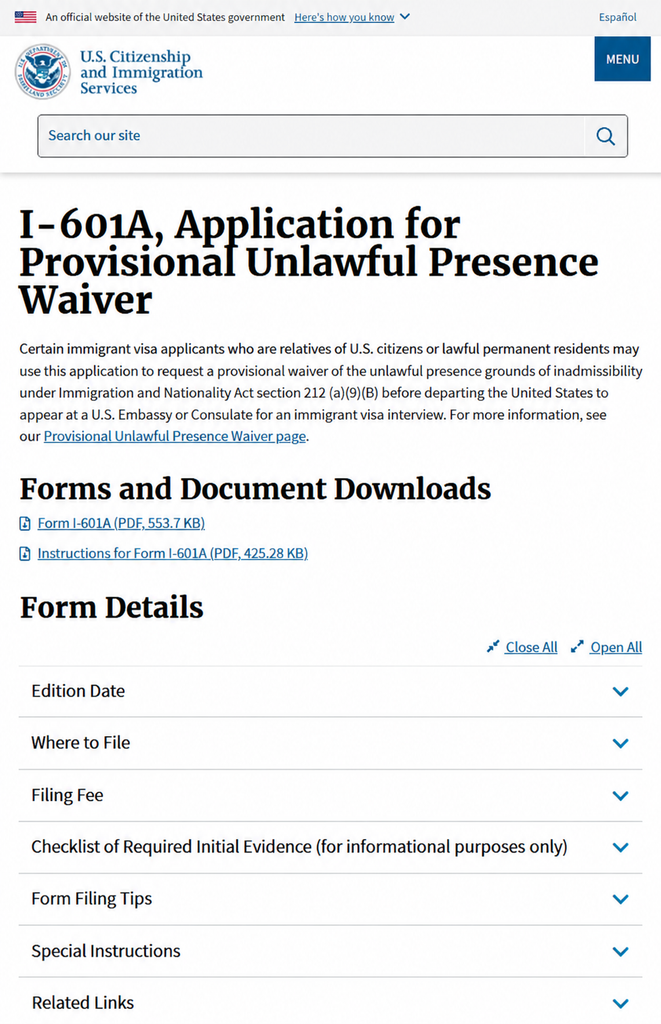
What Is Form I-601A?
Form I-601A is the Application for Provisional Unlawful Presence Waiver.
The word “provisional” is the key. It lets you ask USCIS to forgive your unlawful presence before you leave the United States for your consular interview.
That means you can wait at home with your family while USCIS decides.
You only travel once you know the waiver is approved.
The application is filed from inside the United States before you depart for your immigrant visa interview.
Basic Requirements for the I-601A
The rules are set out in 8 CFR Section 212.7(e). In general, you must:
- Be physically present in the United States when you file and give biometrics (fingerprints and photo) here.
- Be at least 17 years old.
- Have an immigrant visa case pending with the Department of State based on an approved petition, with the State Department’s immigrant visa processing fee already paid.
- Be inadmissible only because of unlawful presence and nothing else.
- Plan to leave the United States to attend your immigrant visa interview.
- Show that being denied would cause extreme hardship to a qualifying relative.
Who Can’t Use the I-601A
The same regulation lists people who are not eligible.
These include anyone in removal proceedings that haven’t been administratively closed, anyone with a final order of removal (unless they already have an approved request for permission to reapply), anyone whose prior removal order has been reinstated, and anyone with a green card application already pending with USCIS.
What the I-601A Does Not Do
A pending or approved I-601A doesn’t give you legal status.
It also doesn’t qualify you for a work permit or travel permission, as the Form I-601A instructions explain.
It also covers one thing only: the three-year and ten-year unlawful presence bars.
If a consular officer finds any other problem at the interview, the approval is automatically revoked under 8 CFR Section 212.7(e)(14).
What Is Form I-601?
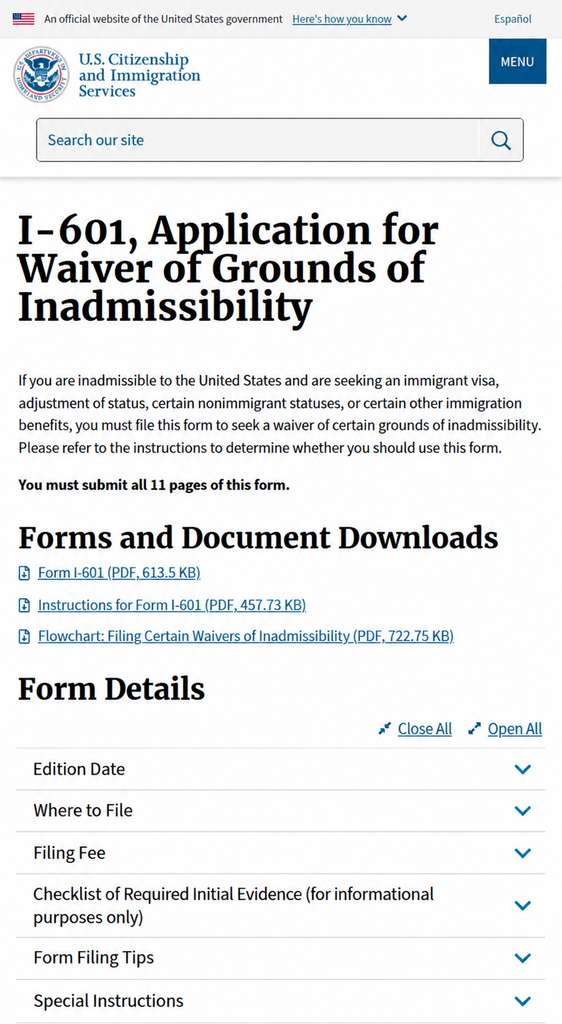
Form I-601 is the Application for Waiver of Grounds of Inadmissibility.
It’s the broader, more traditional waiver. USCIS explains that it’s used by people seeking an immigrant visa, adjustment of status, and certain other benefits who are inadmissible on a ground that can be waived.
Unlike the I-601A, the I-601 can cover more than unlawful presence.
Depending on your situation, it may address:
- Certain criminal grounds
- Fraud or misrepresentation, such as using false documents in the past
- Some health-related grounds
- Unlawful presence, when the I-601A wasn’t available or wasn’t used
Timing is the big difference. People going through consular processing usually file the I-601 after the consular officer finds them inadmissible at the interview.
That often means waiting outside the United States while the waiver is decided. People adjusting status inside the country may also file it in connection with their green card case.
I-601 vs. I-601A: The Key Differences
Here’s a quick side-by-side to help you see where you might fit:
| I-601A | I-601 | |
|---|---|---|
| What it covers | Unlawful presence only | Several grounds of inadmissibility |
| When you file | Before you leave the country | Usually after a consular officer or USCIS finds you inadmissible |
| Where you wait | In the United States | Often abroad, in a consular case |
| If it’s denied | No appeal. You may file a new I-601A if your State Department case is still pending, or file an I-601 after your interview. | You can also file an I-601 after your interview |
The Unlawful Presence Bars, Explained
Most people asking about the I-601A are dealing with unlawful presence.
That’s time spent in the United States after a visa expired, or after entering without inspection.
Under 8 U.S.C. Section 1182(a)(9)(B), a person who was unlawfully present for more than 180 days but less than one year, and then leaves, can’t return for three years.
A person unlawfully present for one year or more faces a ten-year bar once they leave.
Many family-based applicants have to leave the country to attend their immigrant visa interview at a U.S. consulate abroad.
The moment they leave, the bar kicks in. Without a waiver, they could be stuck outside the country for years.
What Does “Extreme Hardship” Mean?
Both waivers, when used for unlawful presence, require you to prove extreme hardship.
The tricky part is that the hardship has to fall on a qualifying relative, not on you.
For unlawful presence waivers, 8 U.S.C. Section 1182(a)(9)(B)(v) limits qualifying relatives to a U.S. citizen or green card holder spouse or parent.
Your U.S. citizen children are not qualifying relatives for this waiver, even though the hardship to them can still matter if it affects your spouse or parent.
The USCIS Policy Manual’s guidance on extreme hardship explains that officers look at the whole picture.
Health problems, financial strain, family ties, safety conditions abroad, and the emotional impact of separation can all play a role.
Ordinary hardship that comes with any separation usually isn’t enough by itself, so strong evidence matters.
What About the Permanent Bar?
Some people face a harder problem.
Under 8 U.S.C. Section 1182(a)(9)(C), a person who was unlawfully present for more than one year total, or who was ordered removed, and then entered or tried to enter again without inspection, faces what’s often called the permanent bar.
Neither the I-601 nor the I-601A fixes this bar for most people.
If anything in your history involves multiple entries or a past removal, talk with an attorney before you file anything or travel.
Common Mistakes to Avoid
- Filing an I-601A when another ground of inadmissibility, like a past misrepresentation, also applies.
- Focusing the hardship evidence on yourself or your children instead of your qualifying relative.
- Traveling abroad before the I-601A is approved.
- Leaving the country and then reentering without inspection while the case is pending, which automatically revokes an approval.
- Assuming the I-601A lets you get your green card inside the United States. It doesn’t. The approval only takes effect after you leave and attend your interview.
Speak With a Riverside Immigration Waiver Attorney
Choosing between the I-601 and the I-601A isn’t just about paperwork.
It’s about protecting your family from a long separation.
A full review of your immigration history (every entry, every visa, every past case) is the best way to avoid surprises at the consulate.
Fontes Law Group serves families from our offices in Santa Ana and Riverside, with attorneys and staff who speak English and Spanish. Call us at 714-571-0738 to schedule a consultation and talk through which waiver fits your situation.
Helpful Resources
- USCIS Form I-601A, Application for Provisional Unlawful Presence Waiver
- Form I-601A Instructions (PDF)
- USCIS Form I-601, Application for Waiver of Grounds of Inadmissibility
- USCIS Policy Manual, Volume 9, Part B: Extreme Hardship
- 8 CFR Section 212.7, Waiver of Certain Grounds of Inadmissibility
- 8 U.S.C. Section 1182, Inadmissible Aliens
FAQs
Q: Can I file the I-601A if I’m married to a green card holder instead of a citizen?
Possibly. The regulation allows people with a pending immigrant visa case based on an approved petition to apply, and a green card holder spouse or parent can be a qualifying relative. An attorney can confirm whether your specific case is eligible.
Q: Do my U.S. citizen children count as qualifying relatives?
Not for unlawful presence waivers. Only a U.S. citizen or green card holder spouse or parent counts. Hardship to your children can still be relevant if it causes hardship to your spouse or parent.
Q: What happens if my I-601A is denied?
There’s no appeal or motion to reopen. However, you may file a new I-601A as long as your case is still pending with the State Department. You can also choose to attend your interview and file an I-601 afterward.
Q: Can I work while my I-601A is pending?
No. A pending or approved I-601A does not support a work permit or advance parole, and USCIS rejects those requests when they’re filed based on the waiver.
Q: What if I have a criminal record or a past immigration violation?
Then the I-601A alone may not be enough. Other grounds of inadmissibility usually need an I-601, and some situations, like the permanent bar, may not be waivable at all. Get legal advice before filing or traveling.
Q: Does Fontes Law Group help with waivers in Spanish?
Yes. Our team serves clients in both English and Spanish from our Santa Ana and Riverside offices.
Bottom Line
If your only problem is unlawful presence and you’ll be processing your visa abroad, the I-601A usually lets you get a waiver approved before you leave home.
If you face other grounds of inadmissibility, or you’ve already been found inadmissible at your interview, the I-601 is likely the form you need.
Either way, the stakes are high and the details matter.
Fontes Law Group helps Southern California families choose the right path, build strong hardship evidence, and avoid costly mistakes. Call 714-571-0738 to speak with our bilingual team in Santa Ana or Riverside.