

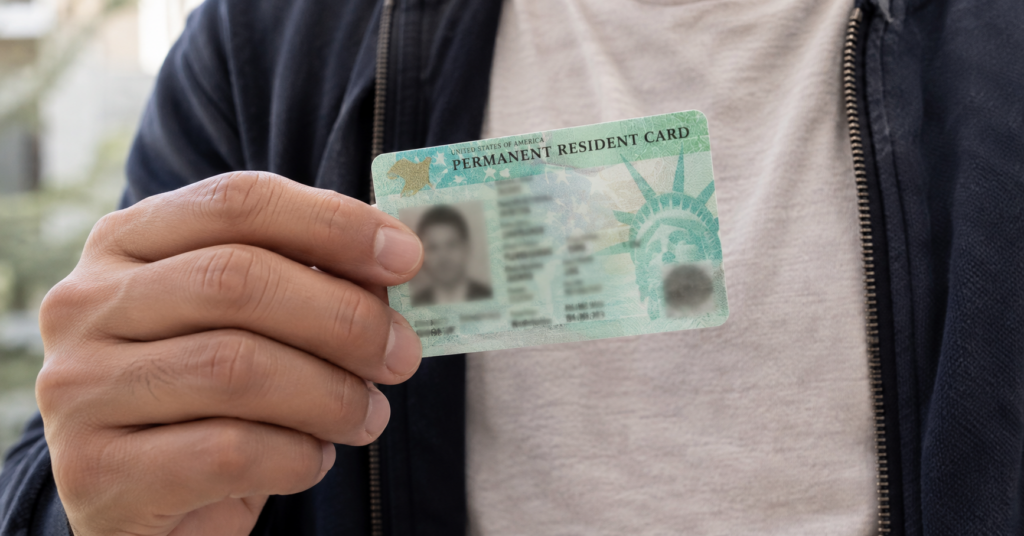
Many families in Santa Ana are asking the same question right now: if we use Medi-Cal or CalFresh, will it hurt a green card case?
The answer changed on September 18, 2026.
It can, but not automatically: for green card applications filed on or after September 18, 2026, USCIS may consider Medi-Cal or CalFresh used from that date forward as one factor in the public charge review, not as an automatic reason to deny the case.
A new federal public charge rule took effect and updated USCIS guidance lets immigration officers look at more types of public benefits than before.
That news has left many parents, spouses, and sponsors unsure whether they should keep their health coverage or food assistance.
At Fontes Law Group, our immigration attorneys help families work through family-based green card cases in English and Spanish. We can look at your filing date, the benefits your household uses, and your full financial picture, then explain what the new rule means for you.
The goal is simple: help you make informed choices without giving up care your family may need.
What Is the Public Charge Rule?
Public charge is a ground of inadmissibility in federal immigration law.
Under 8 U.S.C. Section 1182(a)(4), a person applying for a green card can be found inadmissible if an officer believes they are likely at any time to become a public charge.
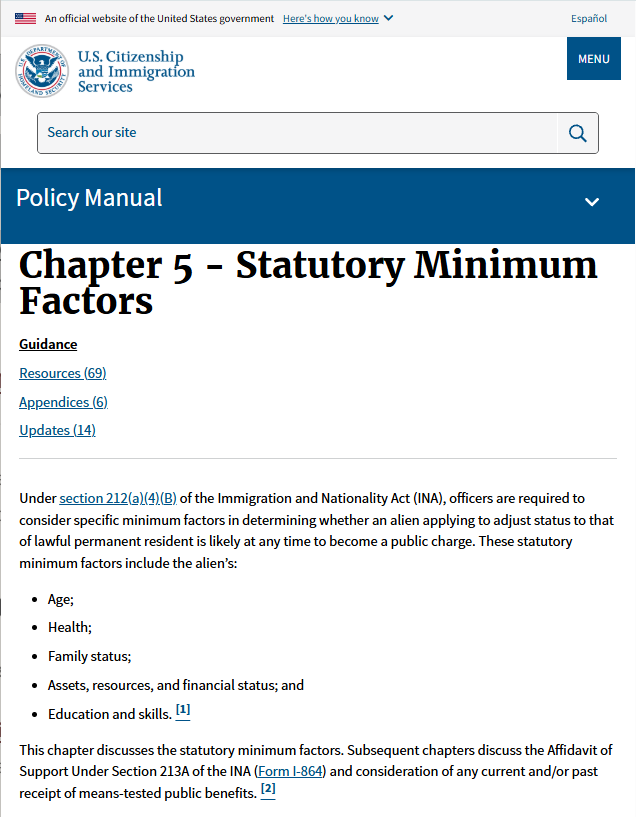
The law requires officers to consider, at a minimum, the applicant’s age, health, family status, assets, resources, financial status, education, and skills.
It is important to know what the rule does not do.
According to the California Health and Human Services Agency, public charge is an immigration rule, not a rule about who can get benefits.
It does not decide whether you qualify for Medi-Cal, CalFresh, or other programs.
What Changed on September 18, 2026
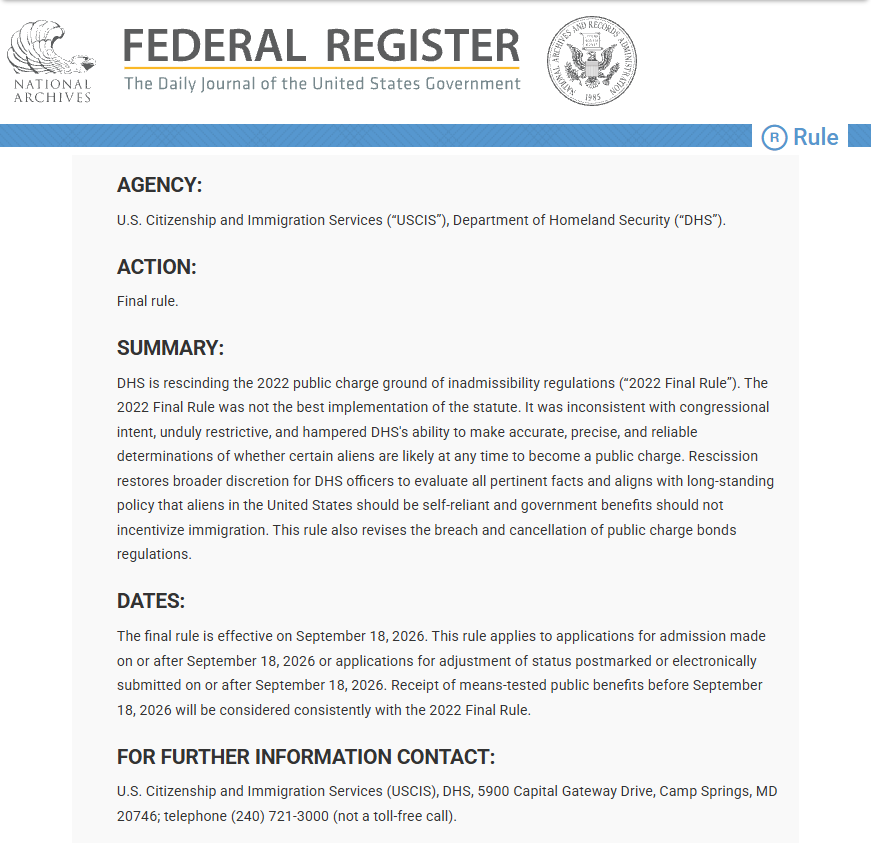
The Department of Homeland Security rescinded the 2022 public charge regulations through a final rule published in the Federal Register on July 20, 2026.
The rule took effect on September 18, 2026.
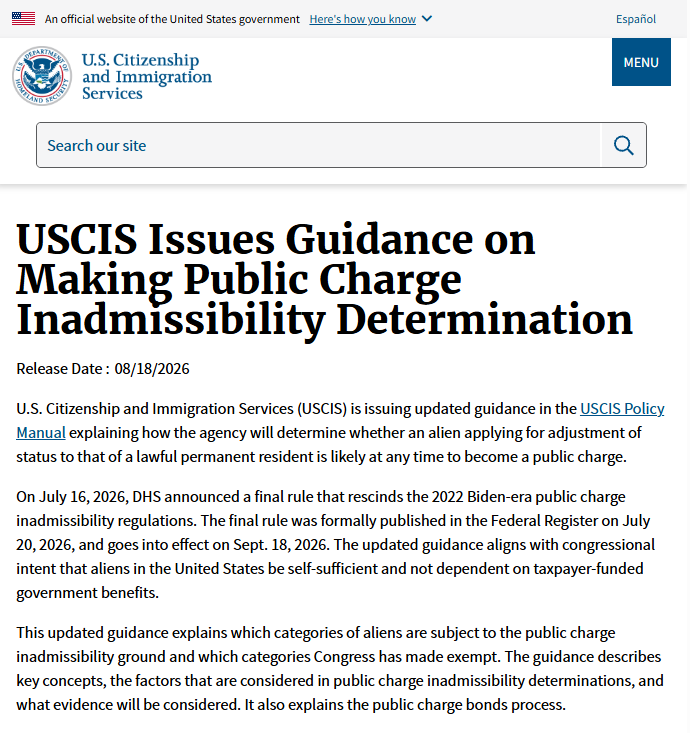
In August 2026, USCIS updated its policy manual to explain how officers will make public charge decisions once the rule took effect.
Under the 2022 rule, officers mainly looked at cash assistance and long-term care in an institution paid for by the government.
Under the new guidance, USCIS says officers can consider a wider range of means-tested benefits, including housing assistance and food stamps, as explained in its August 2026 public charge guidance announcement.
The California Department of Health Care Services confirms this can include Medi-Cal and CalFresh.
Officers can look at whether an applicant applied for, was approved for, or actually received a means-tested benefit.
The USCIS Policy Manual section on public charge also makes clear that officers review the full record, looking at the totality of the circumstances.
Using a benefit is one factor.
It does not automatically lead to a denial.
Why Your Filing Date and Benefit Dates Matter
Timing plays a big role in how the new policy applies.
Benefits such as Medi-Cal or CalFresh received before that date are not counted under the new, broader approach.
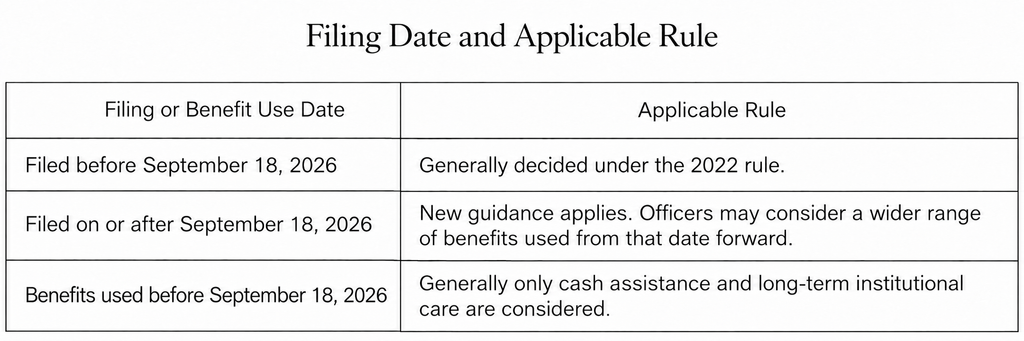
The Federal Register notice explains that the new rule applies to green card applications postmarked or electronically submitted on or after September 18, 2026.
Applications filed before that date are still decided under the 2022 rule. The date you received benefits matters too.
For benefits received before September 18, 2026, USCIS will only consider cash assistance for income maintenance and long-term institutional care at government expense.
What About Benefits Your Children or Other Family Members Receive?
Many families in Santa Ana include U.S. citizen children who get Medi-Cal or CalFresh in their own names.
According to the Catholic Legal Immigration Network, USCIS will not automatically count a U.S. citizen child’s Medi-Cal or CalFresh as the parent’s own, even if the parent applied for it on the child’s behalf.
However, the USCIS Policy Manual says a household member’s benefits can matter if they are your source of financial support or if you are legally obligated to support that person.
Since parents are usually responsible for supporting their children, have an attorney review your household before making any changes.
Who the Public Charge Rule Does Not Apply To
According to the San Francisco Human Services Agency, the rule does not apply to U.S. citizens, people not seeking a green card, or many humanitarian immigrants such as refugees and asylees.
It also generally does not apply to current green card holders, unless they leave the country for more than six months.
The Affidavit of Support Still Matters
Most family-based applicants need a sponsor to sign an Affidavit of Support (Form I-864), and under 8 U.S.C. Section 1183a, agencies can ask that sponsor to repay means-tested benefits the immigrant receives.
The Catholic Legal Immigration Network notes that the new guidance gives the affidavit less weight and looks more closely at the applicant’s own income, assets, education, health, and health insurance coverage.
Should You Stop Using Medi-Cal or CalFresh?
Don’t cancel benefits in a panic.
The CalHHS Public Charge Guide recommends getting the facts about your own case first.
Dropping coverage may not help your application, especially since USCIS looks at health insurance coverage as a factor.
The rule may also change.
The California Department of Health Care Services reports that California is a lead plaintiff in a multistate lawsuit challenging it.
If a family member will apply at a U.S. consulate abroad, different rules may apply.
The Catholic Legal Immigration Network notes that the Department of State uses its own public charge definition in its Foreign Affairs Manual and is not directly bound by the DHS approach, so talk with an immigrationattorney before anyone travels.
Speak With a Santa Ana Green Card Attorney
If you or someone in your family uses Medi-Cal, CalFresh, or other benefits and is planning to apply for a green card, you do not have to sort through these changes alone.
Fontes Law Group can review your situation, explain how the new public charge policy applies, and help you prepare a strong application.
Call our Santa Ana office at 714-571-0738 to schedule a consultation. We serve families in English and Spanish.
Helpful Resources
- USCIS: Guidance on Making Public Charge Inadmissibility Determinations
- Federal Register: Public Charge Ground of Inadmissibility Final Rule (July 20, 2026)
- USCIS Policy Manual, Volume 8, Part G, Chapter 5: Statutory Minimum Factors
- California Health and Human Services Agency: Public Charge Information
- CalHHS Public Charge Guide for Families (September 2026)
- California Department of Health Care Services: Tracking Federal Impact on Medi-Cal Eligibility
Frequently Asked Questions
Q: Will my green card be denied if I used Medi-Cal?
Not automatically. Under the new guidance, Medi-Cal used on or after September 18, 2026 can be considered, but it is one factor among many. Officers look at your full situation, including income, assets, education, skills, health, and your sponsor’s Affidavit of Support.
Q: Does my U.S. citizen child’s Medi-Cal or CalFresh count against me?
Your child’s benefits are generally not treated as your own. USCIS may still consider them if those benefits are your source of financial support or if you are legally required to support that child. An attorney can review how this applies to your household.
Q: I filed my green card application before September 18, 2026. Does the new rule apply to me?
Generally, no. Applications postmarked or electronically submitted before September 18, 2026 are decided under the 2022 rule, which mainly considers cash assistance and long-term institutional care.
Q: I already have a green card. Can using Medi-Cal or CalFresh affect my status now?
The public charge test generally does not apply to current green card holders. An exception can arise if you leave the United States for more than six months and then seek to return. Talk with an attorney before any long trip abroad.
Q: Do WIC or school meals count under the new rule?
They may. The San Francisco Human Services Agency lists WIC and school meals among the non-cash, income-based benefits that may now be considered. As with Medi-Cal and CalFresh, they are weighed as part of your overall situation.
Q: Should I cancel my family’s benefits before I file?
Not without advice. California agencies urge families to get the facts about their own case before stopping benefits. Canceling coverage may leave your family without care and may not help your application. A consultation can help you understand your real risk before you make any changes.