

Marriage fraud is a serious violation of federal immigration law, carrying criminal prosecution, visa denial, removal proceedings, and a permanent bar to future immigration benefits.
A marriage-based green card case turns on one question: was the marriage entered into in good faith, or was it a vehicle to evade U.S. immigration law?
USCIS does not require couples to prove their marriage will last, only that it was genuine when it began.
At Fontes Law Group, our immigration attorneys help clients throughout Santa Ana and Riverside build the kind of evidence USCIS expects to see in a marriage-based case, and we represent couples who have already been flagged.
Here is what the law actually says about marriage fraud, what triggers an investigation, and what is at stake if USCIS believes a marriage was entered into to evade immigration law.
The Case That Put Marriage Fraud Back in the Headlines
On August 12, 2026, USCIS announced it had helped bring down a marriage fraud network charged with arranging more than 1,000 sham marriages since 2016, mostly pairing Chinese nationals with paid U.S. citizens.
Foreign nationals reportedly paid up to $100,000 for a staged marriage, and U.S. citizens up to $30,000 to participate, complete with staged ceremonies, coached interviews, and fabricated records.
Cases this size are rare, but they shape how USCIS reviews every marriage-based petition.
When a scheme like this makes headlines, adjudicators look harder at the same evidence it faked, which means honest couples need to be ready to show the difference.
What USCIS Looks For in a Marriage-Based Petition
The USCIS Policy Manual and the instructions to Form I-130, Petition for Alien Relative, point to a similar set of proof, including:
- Joint financial ties, such as shared bank accounts, joint credit cards, or tax returns filed as married
- Shared residence, shown through a joint lease, mortgage, or utility bills at the same address
- Insurance policies, retirement accounts, or wills that name each spouse as a beneficiary
- Photographs of the couple together over time, in different settings and with family or friends
- Sworn statements from relatives, friends, or clergy who know the relationship is real
- Birth certificates of children the couple has together, when applicable
Officers weigh the quality and consistency of this evidence, not just the volume.
A thin paper trail does not automatically mean fraud, but it does invite a closer look and, often, a request for more documentation.
Red Flags That Can Trigger a Fraud Investigation
Certain patterns cause USCIS to scrutinize a marriage-based case more closely.
None of these facts alone proves fraud, and many describe perfectly genuine relationships, but each one raises the odds of a Request for Evidence, a Notice of Intent to Deny, or a referral for investigation:
- Answers about basic facts of the relationship, like how the couple met or a spouse’s family, that are inconsistent between the petitioner and beneficiary
- Little to no evidence of a shared life, such as no joint accounts, no shared address, or few photographs together
- A very short courtship, especially when few family members or friends knew about the relationship before the wedding
- A marriage that took place shortly after a visa denial, a status violation, or the start of removal proceedings
- Any evidence that money or gifts changed hands in exchange for the marriage
- The petitioner having a prior marriage to a different foreign national that also led to a green card
- Prior fraud findings or flags in State Department or USCIS records involving either spouse
If several of these factors line up in one case, adjudicators are far more likely to order a deeper look before approving a petition.
What Happens If USCIS Suspects Your Marriage Is Fake
When a marriage-based case raises fraud indicators, USCIS typically follows a set process rather than denying the petition outright.
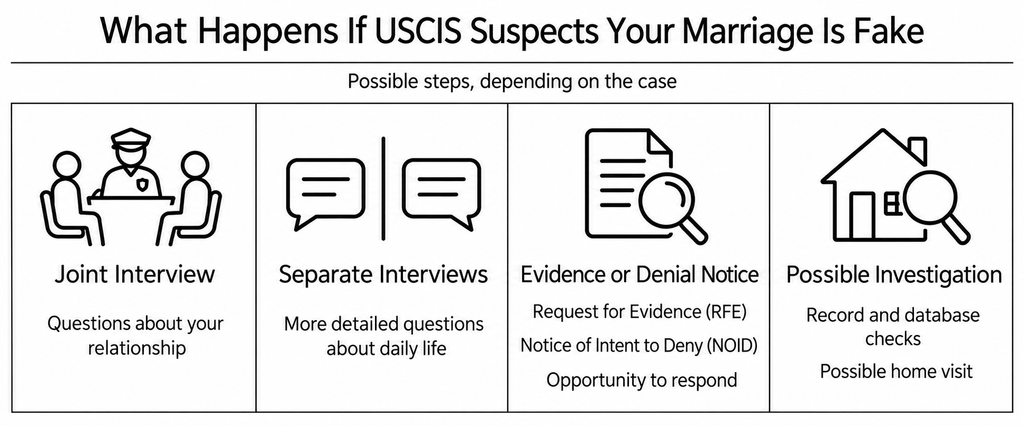
Couples are usually interviewed together first.
If the officer is not satisfied, the couple may be separated and asked more detailed questions about their daily life, meant to reveal whether they actually live the marriage they described on paper.
From there, USCIS can issue a Request for Evidence asking for more documentation, or a Notice of Intent to Deny that lays out the specific concerns and gives the couple a chance to respond before a final decision.
Cases with strong fraud indicators can also be referred to USCIS’s Fraud Detection and National Security Directorate for a more formal investigation, which may include record checks, database searches, and even a visit to the address listed on the petition.
The Consequences of a Marriage Fraud Finding
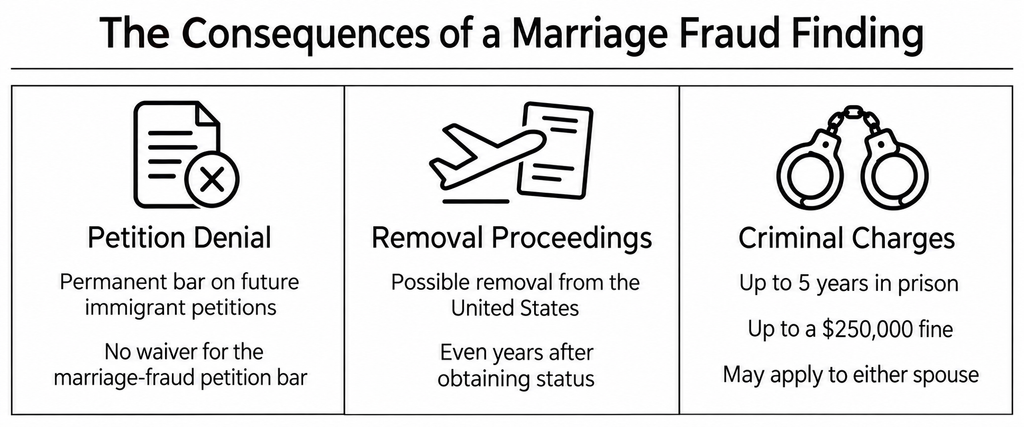
If USCIS ultimately determines that a marriage was entered into to evade immigration law, the consequences reach well beyond a simple denial.
Petition Denial and a Permanent Bar on Future Petitions
A formal fraud finding does not just end the current petition.
Under Section 204(c) of the Immigration and Nationality Act, 8 U.S.C. § 1154(c), USCIS cannot approve any future immigrant visa petition filed on behalf of a person who has been found to have entered into, or attempted to enter into, a marriage to evade the immigration laws.
This bar applies even if the person never received a benefit from the fraudulent marriage, and it has no waiver.
Because the stakes are permanent, USCIS must have substantial and probative evidence of fraud, not just suspicion, before it can invoke this bar, and that evidentiary standard is exactly where a strong response can make the difference.
Removal from the United States
A foreign national who is found to have obtained a visa, green card, or adjustment of status through a fraudulent marriage can also be placed in removal proceedings.
This can happen even years later, for example if the fraud comes to light during a later naturalization application.
Depending on the circumstances, a person facing this ground of removal may be able to seek a waiver, but that relief is discretionary and far from guaranteed.
Criminal Charges
Marriage fraud is also a federal crime.
Under 8 U.S.C. § 1325(c), anyone who knowingly enters into a marriage for the purpose of evading immigration law can be imprisoned for up to five years, fined up to $250,000, or both.
The statute applies equally to the foreign national and the U.S. citizen spouse, and prosecutors can also bring charges under related statutes covering false statements on immigration forms.
The August 2026 indictment illustrates how seriously federal prosecutors treat organized schemes, but even a single couple can face charges if investigators believe the marriage was a sham.
Why Innocent Couples Still Need an Immigration Attorney
Most couples caught up in a fraud inquiry are not part of any scheme.
They are real spouses who fell short on paperwork, who married quickly for personal reasons unrelated to immigration, who come from a culture where family involvement in marriage looks different than what an officer expects, or who simply gave inconsistent answers because they were nervous in an interview.
The problem is that USCIS does not have to prove fraud beyond a reasonable doubt to deny a petition or apply the permanent bar.
Once fraud indicators appear, the burden shifts to the couple to overcome the government’s concerns with substantial and probative evidence of their own.
Waiting to see what happens, or responding to a Request for Evidence without legal guidance, can turn a fixable paperwork gap into a permanent bar or a referral to Immigration and Customs Enforcement.
An immigration attorney can help a couple gather the right categories of evidence before the interview, prepare for the specific questions officers ask in a Stokes-style separated interview, and respond to a Request for Evidence or Notice of Intent to Deny with a legal argument tailored to the facts, not just more paperwork.
If a fraud finding has already been made, an attorney can also evaluate whether a waiver of removability is available and build the strongest possible case for it.
Why Choose Fontes Law Group
At Fontes Law Group, we combine years of immigration and family law experience with a client-first approach. We understand how stressful it is to have a marriage-based case questioned, and we guide clients through the process with clarity and strong advocacy.
- Direct experience with marriage-based green cards, K-1 and K-3 visa cases, and removal defense
- A bilingual legal team serving clients in English and Spanish
- Office locations in Santa Ana and Riverside
- No fees for your initial consultation
- A trusted reputation among immigrant families across Southern California
Speak With a Santa Ana Immigration Attorney
If USCIS has questioned your marriage, scheduled a follow-up interview, or issued a Request for Evidence or Notice of Intent to Deny, do not wait to get legal advice.
Fontes Law Group can review your case, help you understand what USCIS is actually asking for, and build the evidence to support your petition. Call our Santa Ana office at 714-571-0738 or our Riverside office at 951-276-9999 to schedule your free initial consultation.
Helpful Resources
USCIS: Takedown of Decade-Long Marriage Fraud Ring (news release)
USCIS Policy Manual, Volume 7, Part B: Establishing a Bona Fide Marriage
USCIS: Form I-130, Petition for Alien Relative
8 U.S.C. § 1325: Improper Entry by Alien (Marriage Fraud)
8 U.S.C. § 1154: Procedure for Granting Immigrant Status (Section 204(c) Bar)
eCFR: 8 CFR § 204.2, Petitions for Relatives
FAQs About Marriage Fraud and Immigration
Q: What counts as marriage fraud under immigration law?
Marriage fraud means entering into a marriage for the primary purpose of evading U.S. immigration law, most often to obtain a green card. A marriage that later ends in divorce is not fraud on its own. What matters is the couple’s intent at the time they married.
Q: What are the penalties for marriage fraud?
Under 8 U.S.C. § 1325(c), a conviction can bring up to five years in prison, a fine of up to $250,000, or both, for either spouse.
Q: Does USCIS have to prove fraud beyond a reasonable doubt to deny our case?
No. USCIS applies a lower standard than a criminal court. A finding that invokes the permanent bar under Section 204(c) requires substantial and probative evidence of fraud, but that is still a lower bar than the criminal standard, which is one reason a well-documented response matters so much.
Q: Can a genuinely married couple still be flagged?
Yes. Inconsistent interview answers, a short courtship, limited joint finances, or cultural differences in how a marriage was arranged can all raise red flags even when the relationship is completely real. Being flagged is not the same as being found fraudulent, but it does mean the couple needs to respond with strong evidence.
Q: What is the Section 204(c) permanent bar?
It is a rule under 8 U.S.C. § 1154(c) that permanently blocks approval of any future immigrant petition for a person USCIS has found entered into a marriage to evade immigration law. It applies even if no benefit was ever obtained, and there is no waiver for it.
Q: What should I do if I receive a Request for Evidence or Notice of Intent to Deny?
Read it carefully, note the deadline, and contact an immigration attorney before responding. These notices identify specific concerns, and a response that addresses them directly, with the right documentation, gives your case the best chance of approval.