


No one in California is legally required to sign a prenup before getting married.
A prenuptial agreement (California law calls it a premarital agreement) lets you and your future spouse decide ahead of time how certain property and money matters will be handled.
Whether you need one depends on what you are bringing into the marriage, what you expect to build together, and how much say you want over those decisions if the marriage ends.
For some couples, a prenup brings real peace of mind. For others, California’s default rules already work well.
If you decide a prenup is right for you, the family law attorneys at Fontes Law Group can help you draft or review an agreement that protects your interests and holds up under California law.
What Happens If You Marry Without a Prenup in California
California is a community property state.
Under California Family Code Section 760, property acquired by a married person during the marriage while living in California is generally community property.
That usually includes wages earned during the marriage, a home bought during the marriage, and retirement contributions made during the marriage.
Separate property generally includes what each spouse owned before the marriage, plus gifts and inheritances received by one spouse.
As the California Courts on property and debts explains, in a divorce each spouse generally keeps their separate property and the community property is divided.
Debts follow similar rules, so a debt taken on during the marriage can be shared even if only one name is on it.
If you do nothing, these default rules decide the outcome.
A prenup is simply a way to write your own rules instead.
What a Prenup Can and Cannot Cover
California Family Code Section 1612 lists the subjects couples can address in a premarital agreement.
Premarital agreements can cover:
- Who owns the property each of you has now or acquires later, wherever it is located
- How property can be bought, sold, managed, or used during the marriage
- How property will be divided upon separation, divorce, or death
- Wills, trusts, or other arrangements needed to carry out the agreement
- Ownership of life insurance death benefits
- Which state’s law will govern the agreement
- Other personal rights and obligations, as long as they do not violate public policy or a criminal law
Premarital agreements cannot cover:
A prenup cannot reduce a child’s right to support, and child custody cannot be decided in advance, since courts base those decisions on the child’s best interests at the time.
Spousal support also has special rules. Under Section 1612, a spousal support waiver is not enforceable if the spouse giving up support had no independent attorney when signing, or if the waiver is unconscionable when someone tries to enforce it.
Pros of Getting a Prenup
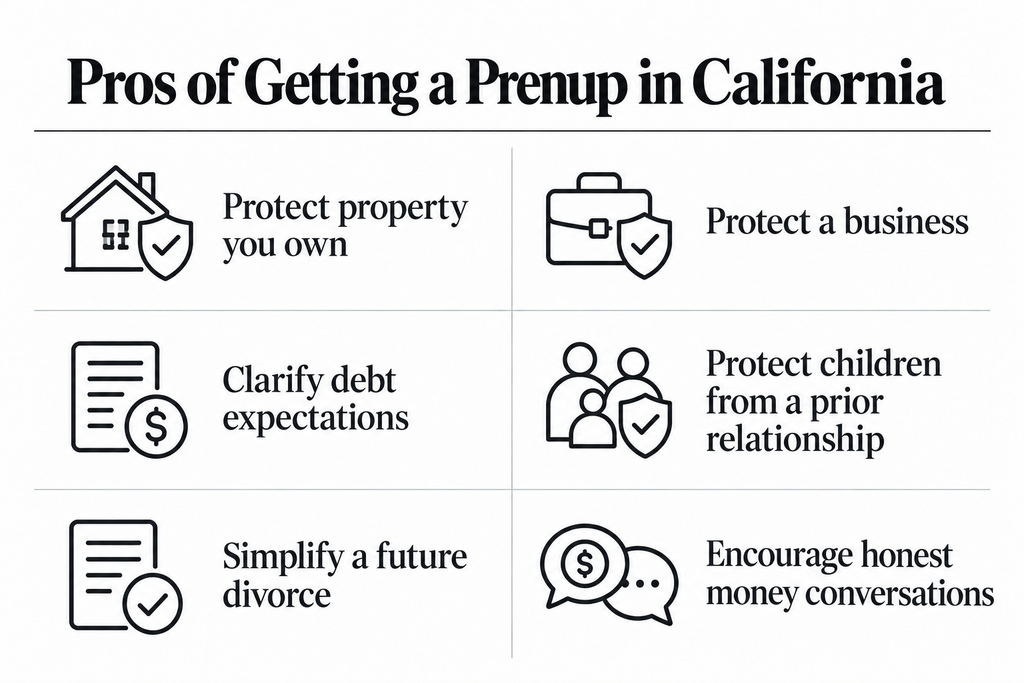
It protects property you already own
If you own a home, investments, or savings before marriage, a prenup can confirm those assets stay separate. It can also address how any growth in value will be treated, which is where many disagreements start.
It protects a business
If you own a business or professional practice, a prenup can spell out how the business and its income will be treated. That can protect business partners and keep operations steady if the marriage ends.
It sets expectations about debt
A prenup can address how existing debts, like student loans or business loans, will be handled between the two of you. This helps both spouses understand what they are and are not taking on.
It protects children from a prior relationship
In blended families, a prenup can work alongside a will or trust to make sure certain assets pass to your children, while still providing for your new spouse.
It can make a future divorce simpler
When major financial questions are settled ahead of time, there are fewer issues left to resolve. That can mean less stress, less conflict, and a faster process.
It encourages honest money conversations
Both partners share their full financial picture before marriage. Many couples find this builds trust and helps them plan their future together.
Cons of Getting a Prenup
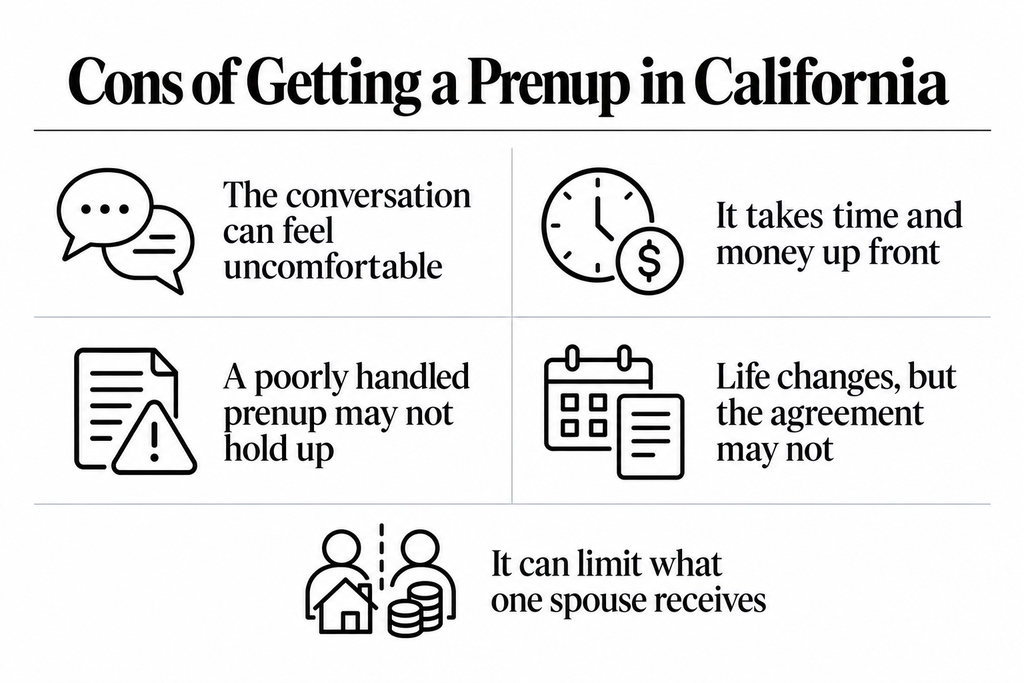
The conversation can feel uncomfortable
Talking about divorce before the wedding is not romantic. Some partners feel hurt or pressured, especially if the topic comes up late in wedding planning.
It takes time and money up front
A solid prenup involves full financial disclosure, negotiation, and ideally a separate attorney for each partner. That is an investment made before any problem exists.
A poorly handled prenup may not hold up
If an agreement is rushed, signed under pressure, or missing key disclosures, a court may refuse to enforce it. A prenup that fails can leave both spouses worse off than having none at all.
Life changes, but the agreement may not
Careers shift, children arrive, and one spouse may step away from work to care for the family. Terms that seemed fair at signing may not fit years later unless you update them.
It can limit what one spouse receives
A prenup often means one partner gives up community property rights they would otherwise have. That partner should fully understand the trade-off before signing.
Who Should Consider a Prenup
A prenup is worth a serious conversation if any of these apply to you:
- You own a business, professional practice, or real estate
- You have significant savings, investments, or retirement accounts before marriage
- You expect to receive an inheritance or family property
- You have children from a prior relationship
- You or your partner carry significant debt
- There is a large difference in income or assets between you
- You are remarrying after a divorce
- One of you plans to leave work to raise children and wants that sacrifice recognized
What Makes a Prenup Enforceable in California
Under California Family Code Section 1611, a premarital agreement must be in writing and signed by both parties. Beyond that, California has some of the strictest rules in the country for how a prenup is signed.
California Family Code Section 1615 says a prenup is not enforceable if the spouse challenging it proves they did not sign voluntarily.
It can also be thrown out if it was unconscionable when signed and that spouse did not receive fair and full financial disclosure, did not waive disclosure in writing, and did not otherwise have adequate knowledge of the other person’s finances.
To find that a prenup was signed voluntarily, the court must confirm all of the following:
- The challenging spouse had an independent attorney, or was advised to get one and waived that right in a separate writing
- The advice to get an independent attorney came at least seven calendar days before the final agreement was signed
- For agreements signed on or after January 1, 2020, at least seven calendar days passed between receiving the final agreement and signing it, whether or not the spouse had an attorney
- A spouse without an attorney was fully informed in writing of the terms and the rights being given up, and was proficient in the language used for the explanation and the agreement
- No one signed under duress, fraud, or undue influence, and both parties had the capacity to sign
The language requirement matters for many of the families we serve. If one partner is more comfortable in Spanish, the explanation of their rights must be in a language they truly understand.
Our bilingual team can help make sure both partners know exactly what they are signing.
The practical lesson is simple: start early. Presenting a prenup days before the wedding invites a challenge later. Begin the process months ahead so there is time for disclosure, review, and changes.
Already Married? A Postnuptial Agreement May Help
If you are already married, it is not too late.
A postnuptial agreement can address many of the same issues as a prenup.
Because spouses owe each other special duties of good faith and fair dealing, courts look closely at these agreements.
Full disclosure and independent legal advice are just as important after the wedding as before it.
Speak With a Santa Ana or Riverside Family Law Attorney About a Prenup
Every couple is different, and there is no one right answer to whether you need a prenup.
What matters is making the decision with clear information and an agreement built to hold up.
At Fontes Law Group, our family law attorneys help couples in Santa Ana, Riverside, and throughout Southern California draft, review, and update premarital and postnuptial agreements. We serve clients in English and Spanish.
Call 714-571-0738 to schedule a consultation and talk through your options.
Helpful Resources
- California Courts Self-Help Guide: Property and Debts in a Divorce
- California Courts Self-Help Guide: Your Rights in a Divorce, Including Spousal Support
- California Family Code Section 760: Community Property
- California Family Code Section 1611: Prenup Must Be in Writing
- California Family Code Section 1612: What a Prenup Can Cover
- California Family Code Section 1615: When a Prenup Is Not Enforceable
Frequently Asked Questions
Q: Is a prenup required to get married in California?
No. A prenup is completely optional. If you do not sign one, California’s community property rules will govern how property acquired during the marriage is treated.
Q: Can a prenup decide child custody or child support?
No. Under Section 1612, a prenup cannot adversely affect a child’s right to support. Custody and parenting time are decided based on the child’s best interests at the time, not by an agreement made before marriage.
Q: Can I waive spousal support in a prenup?
It is possible, but the rules are strict. A spousal support waiver is only enforceable if the spouse giving up support had an independent attorney when signing, and it cannot be unconscionable at the time it is enforced.
Q: How far before the wedding should we sign a prenup?
At a minimum, seven calendar days must pass between receiving the final agreement and signing it. In practice, it is wise to start months before the wedding so neither partner feels rushed.
Q: Can we change our prenup after we get married?
Yes. After marriage, a premarital agreement can be amended or revoked through a written agreement signed by both spouses. Many couples revisit their agreement after major life changes, such as having children.
Q: Do we both need our own lawyers?
It is not strictly required for every prenup, but it is strongly recommended. Separate attorneys make the agreement much harder to challenge, and independent counsel is required for any spousal support waiver to be enforceable.